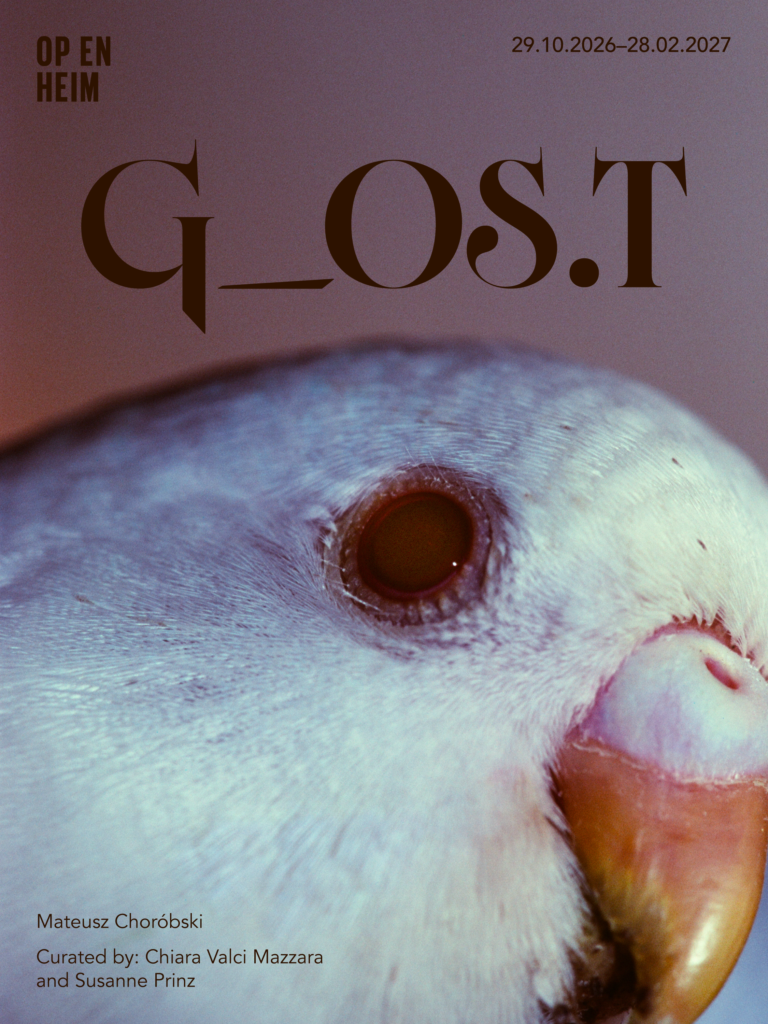
G_OS.T
Mateusz Chorobski
solo show
for
OP-ENHEIM
Curated by Chiara Valci Mazzara and Susanne Prinz
Opening: 29 October 2026, 6:00 PM
VIP preview upon rsvp: October 28, 6:00 PM
29 October 2026–28 February 2027
OP ENHEIM
4 Plac Solny, Wrocław, Poland
|
|
G_OS.T
Mateusz Choróbski
OP ENHEIM, Wrocław & Berlin
The show G_OS.T, conceived by Mateusz Choróbski specifically for OP ENHEIM and realized with the support of the Foundation for Polish-German Cooperation, takes as its starting point the crucial experience of being lost. The project evokes the phenomenon of losing oneself in the world, capturing that precise moment when it feels no longer clear where one is heading or what a “return” might actually mean. The overarching installation, developed across all the floors and species of OP ENHEIM, explores a state of disorientation that bridges our inner emotional lives with our navigation of a changing external world, where personal history and architectures of memory seemingly seem to form the only remaining anchors.
Expanding on themes from the artist’s solo show P.OST conceived for and presented at the Kunstverein am Rosa Luxemburg Platz in Berlin in 2025, the exhibition at OP ENHEIM shifts from physical architectural memory to the psychological weight of displacement and the impossibility of a full return. Based on the cityscapes of Berlin and Wrocław, which meet as spaces of contemporary dialogue, the exhibition designs a topography of longing, loss, uprooting, and return, drawing on historical traces and intertwined biographies.
At the center of the exhibition are the intertwined legacies of the architect Hans Poelzig, whose visionary designs shaped modernist architecture in both landscapes, and the director Erik Charell, whose artistic paths crossed in a momentous way. In Berlin, Poelzig designed the iconic Kino Babylon and the Großes Schauspielhaus, where Charell spent years as artistic director. In Wrocław, Poelzig created the Four Domes Pavilion and the now-defunct Deli cinema. In a poignant, poetic cycle of urban decay, the Arkady Wrocławskie shopping centre—built on the ruins of the Deli cinema—has itself recently closed and is currently being demolished. Charell envisioned a grand film operetta based on Homer’s The Odyssey, but due to his Jewish origins, he was barred from the project and forced to emigrate. Their unfulfilled dreams and lost works become architectural ghosts of a history that cannot be restored, serving as fragments of timelines that can no longer be fully recovered.
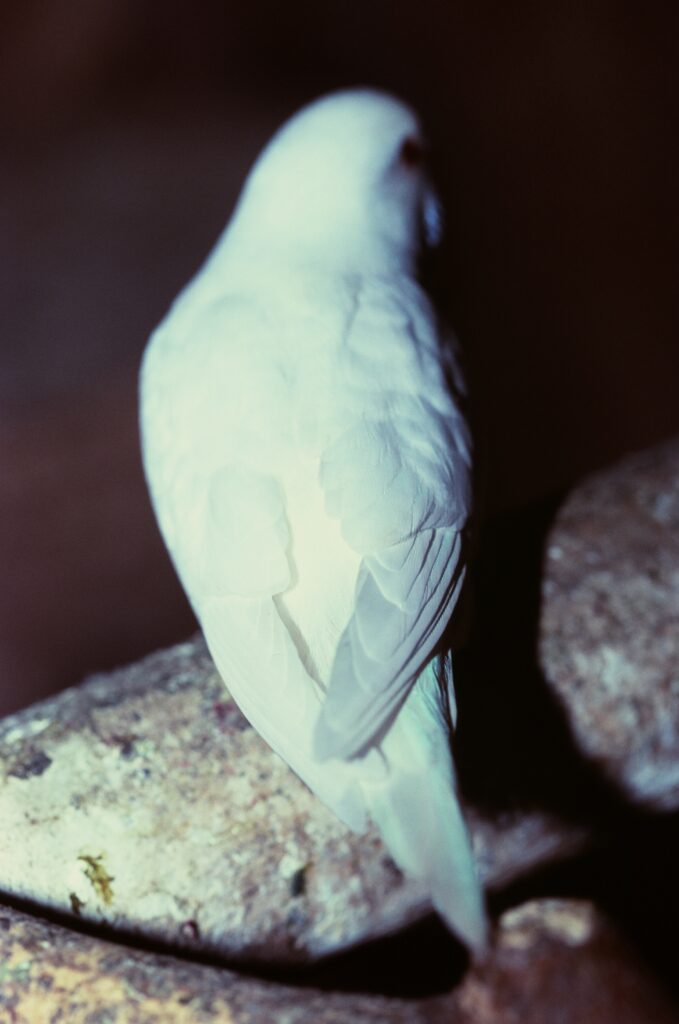
G_OS.T weaves these narratives together through the recurring symbol of a bird or a falcon, connecting the history of the OP ENHEIM building, Charell’s aborted operetta, and Poelzig’s spaces. This includes a historical fragment of a pet budgerigar kept by a past resident family to mask a reality growing ever darker, an albino parrot in the exhibition space serving as a visual anchor for memory losing its clarity. The exhibition engages, too, with the myth of the Homeric sirens, re-imagining them not as monsters, but as longing, isolated beings whose ultimate knowledge became a burden. The experience of losing one’s home unites the literary hero Odysseus, the historical figure Erik Charell, and the past residents of the building. Not everyone was able to return, and those who did found a reality entirely transformed from the one they had longed for, remembered and eventually returned to.
The exhibition title G_OS.T functions as a complex conceptual puzzle and linguistic architecture. It spans a broad arc across layered associations with knowledge, performance, and presence, shifting between ancient knowledge (gnosis) and musical performance (song), referencing the Polish word for voice (głos), and evoking the ghostly (ghost) or the structural blank space left behind by history. Held at OP ENHEIM—a historic building with a rich and troubled past—Choróbski’s site-specific, immersive intervention of sculpture, video, and sound directly intervenes in the building’s physical architecture. The exhibition unfolds in three distinct chapters like an opera, turning the individual floors into stages through which the audience moves on a journey and ventures amidst the echoes of past and present, appealing to all senses through images, sounds, and direct physical experience.
Act I, presents an audio installation that sets the stage for the structural reversals found throughout the exhibition. Developed with composer Michał Jacaszek and the soprano Aleksandra Klimczak, a sound piece syllables on an exhalation and inhalation outside the building, shifting to a reverse laughter inside the stairwell. Act II, articulates as a spatial installation – developed towards and within the walls and architecture of the floor – where visitors navigate a labyrinth constructed from transparent polycarbonate panels. Vertical light installations constructed as vertical sculptural objects from construction stamps and radiators mirror Poelzig’s famous columns, using glass castings made from melted thermos flasks, perfume bottles and cupping glass to tint the light, while a hidden slide projector casts static images of an albino parrot onto the labyrinth’s walls. Act III, physically deconstructs the visual, experiential and auditory narrative into sound, movement, and light across different zones of the building. A soundscape weaves bodily tempos with fragmented Siren songs performed on single inhales and exhales interwoven with singing, while a thermal imaging video work presents scenes of the empty Arkady Wrocławskie and a hotel site in Berlin—once the location of the Großes Schauspielhaus—carrying the history of Poelzig’s architecture. In this footage, an unidentifiable falcon lingers, drifts and gazes across the frame, contributing to a mesmerizing meta-narration where past and present interweave together with interior scenes.
The final EPILOGUE, marking the culmination of the site-specific, multi-layered installation’s vertical axis, takes place on the roof of the building. Here, two functional lamps—sculptural bodies created by the artist—emit the light recorded at Arkady Wrocławskie from one, and the light recorded at the Leonardo Hotel in Berlin from the other. Past and present shimmer back and forth, mirroring the stories of the places where the light was captured, closing the circle with a final act: a tangible record of the past, the present, and the threshold between the two.
Ultimately, the exhibition acts as a decisive impulse, a still life, or a throbbing account through which memory, history, and a sense of place blend into a shared constellation—one where the past continuously returns to us as a trace, an echo, and a shadow.
- Chiara Valci Mazzara-